 Rio Celeste Tours
Tenorio Volcano National Park: Hours, Fees and Trails
Tenorio Volcano National Park is the protected rainforest in northern Costa Rica where the Rio Celeste turns its famous opaque blue. Entry for foreign adults costs $13.56 with tax, tickets must be bought online in advance, and the entry window runs from 8 a.m. to 2 p.m. The main route is a loop of roughly 3.5 to 4 km that takes most visitors 2.5 to 4 hours with stops. You cannot swim anywhere inside the park. This page covers hours, fees, the trails, the river color and the wildlife, and links to the Rio Celeste tours compared side by side so you can weigh a self-guided visit against a guided day before you commit.
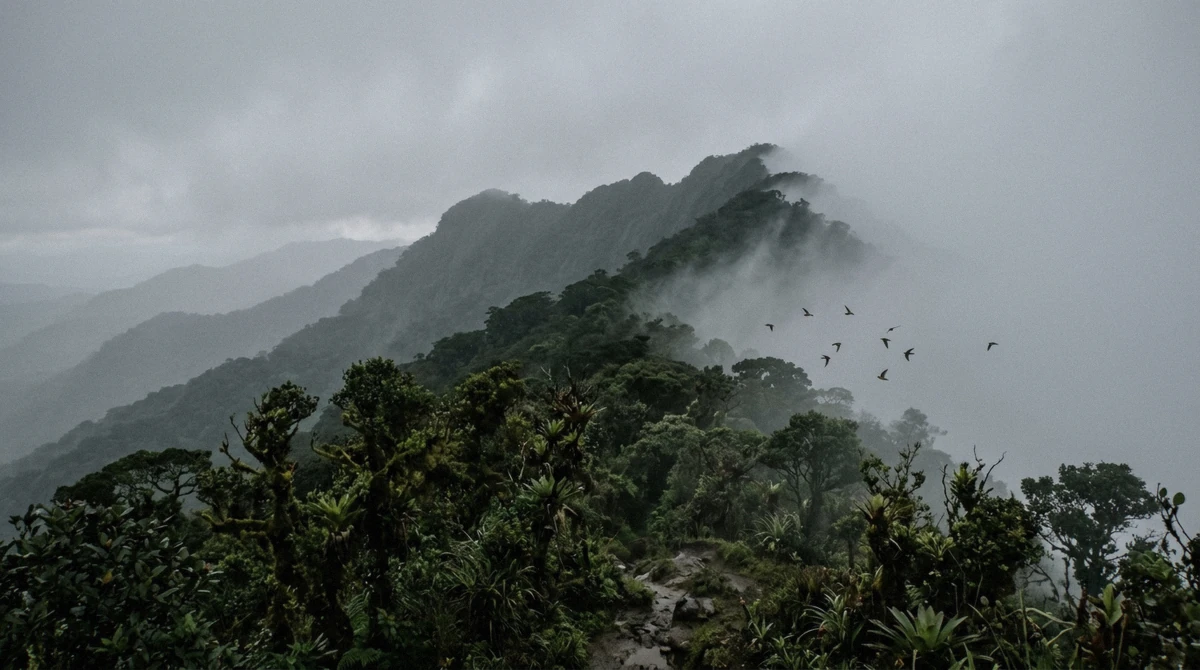
The park protects a cloud forest volcano as much as a river.
Quick answer Entry fees, the 8 a.m. to 2 p.m. ticket window and the one loop trail, in brief
Tenorio Volcano National Park admits visitors in entry slots from 8 a.m. to 2 p.m. and caps the number of daily entries. Foreign adults pay $12 plus 13% tax, about $13.56, and children aged 2 to 12 pay $5 plus tax. Tickets are bought in advance online through SINAC, the national park system, and gate sales are not guaranteed. The standard visit is a 3.5 to 4 km loop taking 2.5 to 4 hours, and swimming is prohibited inside the park.
Key takeaways
- Entry costs about $13.56 for foreign adults including tax and must be reserved online in advance through SINAC.
- The loop trail runs about 3.5 to 4 km and passes the waterfall lookout, hot springs, mud pots, Blue Lagoon and Los Teñideros.
- For a guided option, check the Rio Celeste tour price comparison for prices, durations and departure points.
The Park in One Paragraph
Tenorio Volcano National Park protects the upper reaches of the Rio Celeste in northern Costa Rica. The river is the reason most people come. Its opaque blue is produced inside the park itself, where two streams carrying different volcanic minerals meet and scatter light into a vivid sky color.
The single visitor entrance sits at Pilón, about 20 minutes from the village of Bijagua, reached on a fully paved road. A 4x4 is not needed, though the road is steep in places, slick after rain, and crosses one-lane bridges where you yield to oncoming traffic. There is no reliable public bus to the entrance, so the realistic options are a rental car, a shuttle, or a guided day that includes transport.
The drive from La Fortuna takes about 1.5 hours each way, from Liberia and the northern Guanacaste resorts about 2 to 2.5 hours, and from San Jose about 3.5 to 4 hours. If you plan to self-drive, the routes and turn-offs are set out in How to Get to Rio Celeste: Routes, Roads and Times. One warning from that guide: maps apps often route a left turn too early off Route 4 near San Rafael de Guatuso, and you should continue to Samen before turning.
Hours, Fees and the Entry Cap
The park does not sell walk-up tickets reliably. Entry slots are capped daily and the entry window runs from 8 a.m. to 2 p.m., meaning the last visitors enter at 2 p.m. and the morning slots are the ones that sell out first in peak periods. Tickets are bought in advance online through SINAC, the national park system.
In-person sales at the gate are not guaranteed, so arriving without a reservation is a gamble. An easier route for many visitors is the Rio Celeste Waterfall & Tenorio National Park Entrance Ticket, a reserved timed slot listed at $32 that covers the self-guided trail and frees you from the SINAC booking process.
Fees differ by residency and age. Foreign adults pay $12 plus 13% tax, which comes to about $13.56. Children aged 2 to 12 pay $5 plus tax.
Residents pay in colones at local rates. The Rio Celeste Waterfall & Tenorio National Park Entrance Ticket bundles the reserved slot at a listed price of $32, which is roughly a third of the cost of any guided day in the catalog.
| Visitor type | Published fee | With 13% tax |
|---|---|---|
| Foreign adult | $12 | $13.56 |
| Child aged 2 to 12 | $5 | $5.65 |
| Resident | Paid in colones | not stated |
| Reserved ticket via listing | $32 | included in listed price |
When to enter
The entry window runs from 8 a.m. to 2 p.m. Earlier slots beat both the heat and the tour buses, and the driest months see morning slots fill fastest. Trails close in extreme weather, and the park has closed for floods and landslides in heavy rain, so check status the day before in the wettest stretch.
For month-by-month detail on crowds, heat and color, see When to Visit Rio Celeste: Months, Color and Crowds.
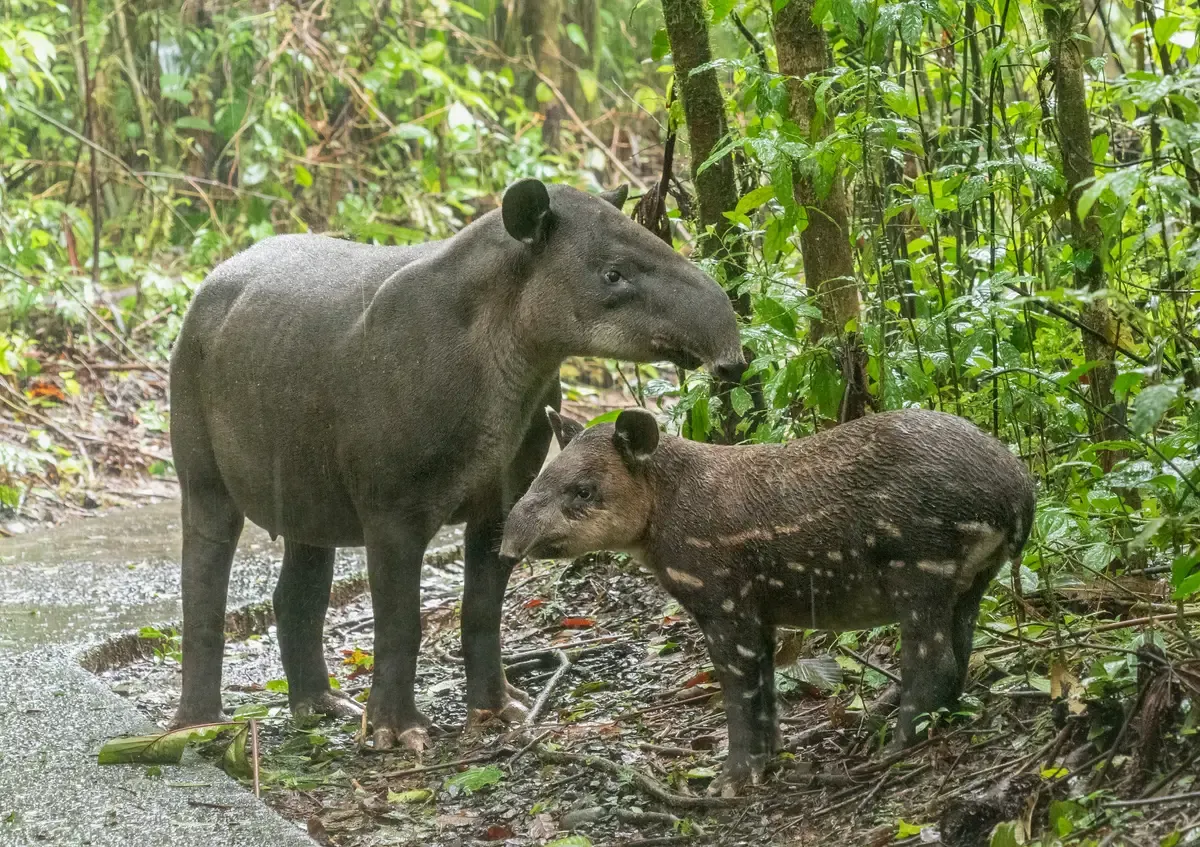
The tapir is the park's prize sighting. Photo: Rhododendrites, CC BY-SA 4.0, via Wikimedia Commons
The Trails and What They Pass
The standard route is a loop of roughly 3.5 to 4 km that takes most visitors 2.5 to 4 hours with stops. The trail was rebuilt so it no longer turns to mud in rain, a real change from older trip reports. The first 20 to 30 minutes are flat and paved, an easy warm-up.
Then a long staircase with a railing drops to the waterfall lookout, which is the physical highlight and the slowest stretch for most people.
What the loop passes
The loop links the signature stops in one walk. Most visitors do them in a single circuit with time standing at each.
- The Rio Celeste waterfall lookout, reached down the long railed staircase
- The hot springs, where mineral-heated water warms the riverbank
- The mud pots, bubbling volcanic activity on the slope
- The Blue Lagoon, a first taste of the river's color
- Los Teñideros, the springs where the two mineral streams meet and the water turns blue
Self-guided visitors doing the loop in about three hours are the typical case, and the Rio Celeste Waterfall & Tenorio National Park Entrance Ticket is built around exactly that. Guided days spend longer on the trail. The Rio Celeste & Tenorio Volcano Hike: Blue River Adventure takes the full trail including the volcano viewpoint, hot springs and mud pots with a guide explaining the chemistry, listed at $92.31 over 8 hours.
For a comparison of how each guided day covers the trail, the trail itself is broken down in The Rio Celeste Hike: Trail, Time and Tickets.
The River and Its Color
The blue is chemistry, not reflection. Two streams carrying different volcanic minerals meet at Los Teñideros, and sulfur meeting calcium carbonate scatters light into an opaque sky blue. The effect is striking enough that it reads almost artificial in photos.
It is not guaranteed, and this is the single most common surprise for visitors.
Heavy rain turns the river green-brown within hours as suspended sediment overwhelms the light scattering. The blue returns as sediment settles in drier weather. This means the season you pick matters as much as the hour.
Verified reviews reflect this directly. One visitor wrote that after heavy rain the water was not as blue as it could have been, and still called the guide fantastic. Another said that even in rain without the blue, the day was still a highlight of the trip.
If the color is the whole point of your visit, plan around the dry months and enter early, since flood surges are most likely in the wettest stretch of the year.
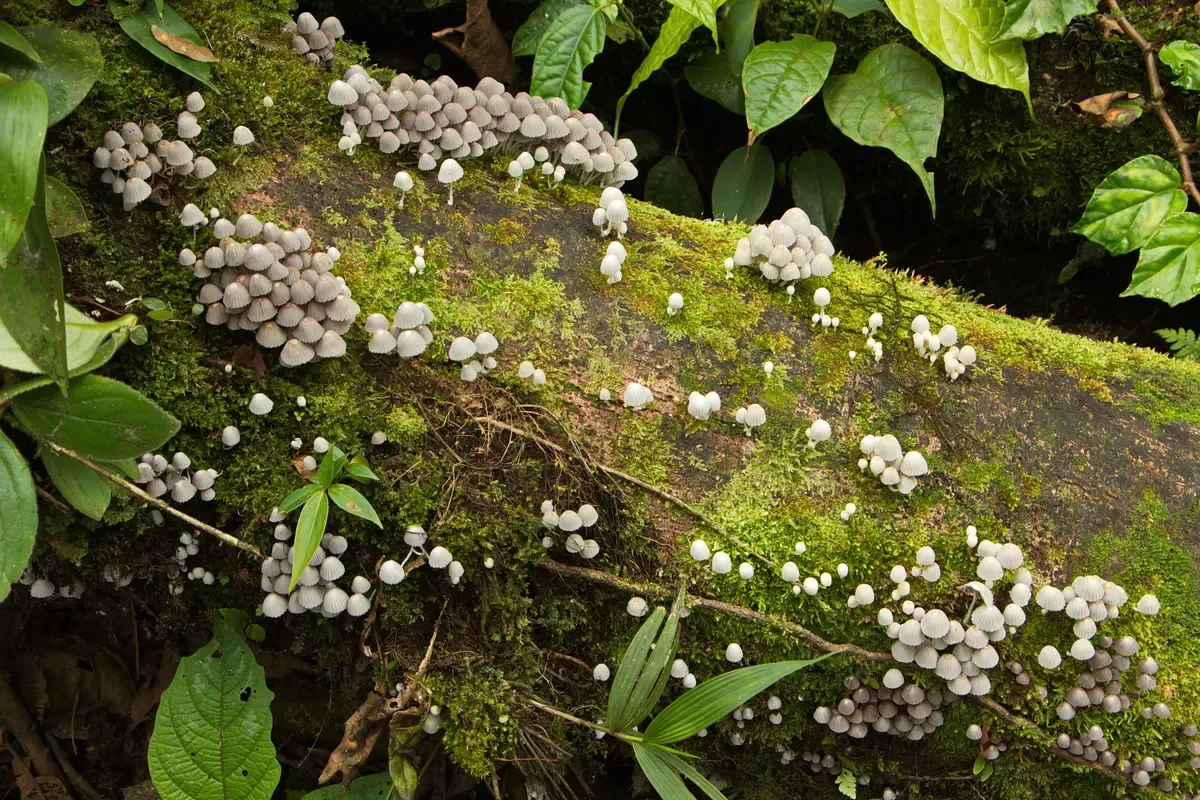
The cloud forest floor does its own exhibition. Photo: Karel Stipek Austria, CC BY 4.0, via Wikimedia Commons
Wildlife and the Forest
The forest around the trail holds sloths, tapirs, toucans, howler monkeys and poison-dart frogs. Sightings are common but never guaranteed, and a guide makes a real difference in spotting them. One verified reviewer described seeing a tapir as a very rare opportunity on a day with a long drive on winding mountain roads.
Sloth-focused add-ons exist just outside the park, where sightings are far more reliable: the Rio Celeste Waterfall & Slothland Excursion pairs the hike with a guided sloth reserve and a coffee and chocolate farm at $118 over 11 hours, and the Rio Celeste Hike, Sloth Sanctuary & Llanos de Cortés Waterfall combines three stops from the Guanacaste resorts at $135 over 12 hours.
If you want to compare all the guided days at once, the lead table of the Rio Celeste tour price comparison lists price, duration, rating and departure base for every listing in the catalog. Prices there run from $32 for a bare entrance ticket to $135 for the triple combo, Anyone deciding whether the day justifies the drive can read the blunt assessment in Is Rio Celeste Worth It? An Honest Verdict.
Park Questions, Answered
The short answers to what visitors ask most often are collected here, with fuller detail in each section above. The essentials: buy your ticket before you drive out, enter in the morning, expect stairs on the waterfall stretch, and do not count on blue water after heavy rain.
How the Park Is Organized
Tenorio Volcano National Park was created in 1976 and protects roughly 12,800 hectares of rainforest and cloud forest wrapped around a dormant volcano of about 1,916 meters. Visitors see a small slice of it: one entrance at Pilón, one main loop trail to the river, and a ranger station that caps entries and closes the trail in bad weather. Everything a first-time visitor needs sits within that slice, which is why the park feels intimate rather than vast.
- One entrance: Pilón, about 20 minutes from Bijagua on a paved road
- One flagship trail: the roughly 3.5-4 km loop to the waterfall and the color change
- One rule that surprises: no swimming anywhere inside the park
- One entry window: 8 a.m. to 2 p.m., with daily slots capped
The volcano itself has no summit trail for visitors; the park's fame lives in the river at its foot, where the volcanic minerals do their chemistry. Hikers who want a summit carry that ambition to other parks, and Tenorio rewards the ones who come for water instead.
Rules Every Visitor Walks Past
The posted rules read strict until you see the reasoning. Swimming is prohibited because the riverbed and its chemistry are the protected thing. Food is kept to the picnic area near the entrance because monkeys and coatis that learn to beg become problems.
Drones are banned for the wildlife as much as for the visitors. None of these rules is enforced from a distance: rangers walk the loop, and the staircase to the waterfall lookout has a steady foot traffic that self-polices.
Two practical rules matter more than the rest for planning. Identification is checked at the gate, so every adult carries a passport or a copy. And the entry window closes at 2 p.m., which turns any Rio Celeste afternoon plan into a plan for Bijagua, the hot springs or the road back instead.
The Science of the Color, Told at the Trailhead
At Los Teñideros, two colorless streams meet. One carries dissolved volcanic minerals dominated by sulfur compounds; the other runs over calcium carbonate it picked up from the limestone on the opposite slope. When they mix, the pH shift makes the silica and carbonate particles clump into sizes that scatter sunlight exactly in the blue range, so the river below the confluence reads an opaque, milky sky-blue while both streams above it look like ordinary jungle water.
The name of the place translates roughly as the bleaching grounds, a reference to the dyeing traditions the color resembles.
- Two streams, two chemistries: sulfur-rich on one side, carbonate-rich on the other
- The mixing point: Los Teñideros, the first stop where the color begins
- The result: suspended particles that scatter blue light, opaque as paint
- The failure mode: heavy rain adds brown sediment and overwhelms the effect
The chemistry explains every rule on this site. Swimming is banned because the particles settle on skin and disturb the riverbed, not because the water is dangerous. The color changes with the weather because sediment is the variable, not the season.
And the best photograph of your visit is as likely to happen under a gray sky as under a blue one, because the water makes its own light.
Visiting With Kids and Older Parents
The loop is doable for three generations if you plan for the stairs. The first section from the entrance is flat and paved, wide enough for grandparents and strollers to the first viewpoints, and the demanding part is the long staircase with a railing down to the waterfall lookout and the return climb. Families with young children regularly turn around at the lookout and skip the far half of the loop, which is a perfectly good day: the waterfall is the headline, and the hot springs and mud pots are the second act.
Two adjustments make the difference between a triumph and a trudge. Start at the 8 a.m. entry so the staircase is climbed in cool shade, and set the turn-around point before anyone is tired rather than after. The reserve lodges around Bijagua, with their flat trails and resident sloths, are the easier wildlife day for the oldest and youngest members of a group, and they pair naturally with the park drive.
What the Park Protects Beyond the River
The river is the headline, but the park's conservation work runs wider. Tenorio sits on the biological corridor that lets jaguars, tapirs and the great flocks move between the Guanacaste range and the central mountains, and the forest you walk through is the corridor's working heart. The entry cap, the trail rules and the banned drones all serve that larger project: the park is managed as habitat first and a visitor attraction second, which is precisely why the visit feels wild rather than staged.
- The corridor: Tenorio links the Guanacaste range to the central mountains
- The species: tapirs, jaguars, great curassows and hundreds of birds use the park
- The cap on entries: protection of the trail and the riverbed, not a revenue rule
- The research: the park hosts ongoing studies of the river's unusual chemistry
That framing changes what a visit is for. The color change is the reason the park is famous, and the forest is the reason it is worth the drive: standing on the hanging bridge while the canopy moves with monkeys, in a park that caps its own visitors to stay wild, is the experience the waterfall only introduces.
Beyond the Main Loop: What Else the Gate Offers
The main loop is why people come, but the entrance area has more to offer than a ticket check. The picnic area near the ranger station is the only place in the park where food is allowed, and it is a good spot for the early lunch before the hike. Shorter paths around the entrance buildings give visitors who cannot manage the stairs a taste of the forest, and the ranger station itself answers the day's practical questions: trail status, water levels, and the day's wildlife reports from the early walkers.
- The picnic area: the only food-legal zone, a short walk from the gate
- Flat entrance paths: a partial experience for visitors who skip the stairs
- The ranger station: trail status, water color reports, wildlife news
- Guides for hire: local naturalists sometimes wait at the entrance
Outside the gate, the community has grown its own ring of experiences: the private reserves, the hanging bridges at nearby lodges, the horseback trails through the pastures, and the river tubing operators working the lower stretches outside the protected section. None of it replaces the loop; all of it turns a half-day visit into a reason to overnight in Bijagua.
Park Questions, Answered
How much do tickets cost to visit Tenorio Volcano National Park?
Foreign adults pay $12 plus 13% tax, about $13.56, and children aged 2 to 12 pay $5 plus tax. Residents pay in colones. Tickets are bought online in advance through SINAC, or you can take a reserved slot listed at $32 through the Rio Celeste Waterfall & Tenorio National Park Entrance Ticket.
Can you swim in Tenorio Volcano National Park?
No. Swimming is prohibited inside the national park, including at the waterfall pool. The known swim spots sit outside the protected section, such as the Llanos de Cortés waterfall, and the Rio Celeste Nature Hike & Swimming at the Blue River builds a legal swim stop into the day.
What time does Tenorio National Park open?
The entry window runs from 8 a.m. to 2 p.m., so the last entry of the day is at 2 p.m. Morning slots are the most reliable for color and light crowds. Trails close in extreme weather and the park has closed for floods and landslides in heavy rain.
Does Tenorio National Park sell out?
It can. Entry slots are capped daily and in-person sales at the gate are not guaranteed. Dry-season mornings book out first, so reserve online in advance through SINAC or take a reserved timed slot rather than gambling on the gate.
What animals live in Tenorio Volcano National Park?
The forest holds sloths, tapirs, toucans, howler monkeys and poison-dart frogs. Sightings are common but never guaranteed, and reviewers describe a tapir encounter as rare. Guides spot far more than untrained eyes, and sloth reserves just outside the park offer more reliable wildlife time.
Is the park the same place as the Rio Celeste waterfall?
The waterfall sits inside Tenorio Volcano National Park, reached down a railed staircase from the loop trail. The river's blue color is produced at Los Teñideros, also inside the park. Visiting the waterfall means entering the park, buying a ticket and following the same capped-entry rules.