 Rio Celeste Tours
Is Rio Celeste Worth It? An Honest Verdict
Is Rio Celeste worth it? For most travelers who can spare a full day, yes: Rio Celeste is worth it for the color alone, and the rest of the day earns its keep. The river really is that blue, the color is volcanic chemistry rather than a camera trick, and the hike through Tenorio Volcano National Park adds hot springs, mud pots and real wildlife on top of the waterfall. It is not a quick roadside stop. The park entrance is remote, entry slots are capped and sold ahead of time, and the drive is long from every direction. The honest caveats are simple: you cannot swim inside the park, the heaviest rain turns the water green-brown, and guided days run $89 to $135 per person with transport often extra. If a full rainforest loop, a dramatic waterfall and the strangest colored river in Costa Rica sound like your kind of day, book it. If you need a swim or a short outing, look at the alternatives below. This page is an honest verdict based on the every Rio Celeste tour compared on this site, verified reviews and park rules.
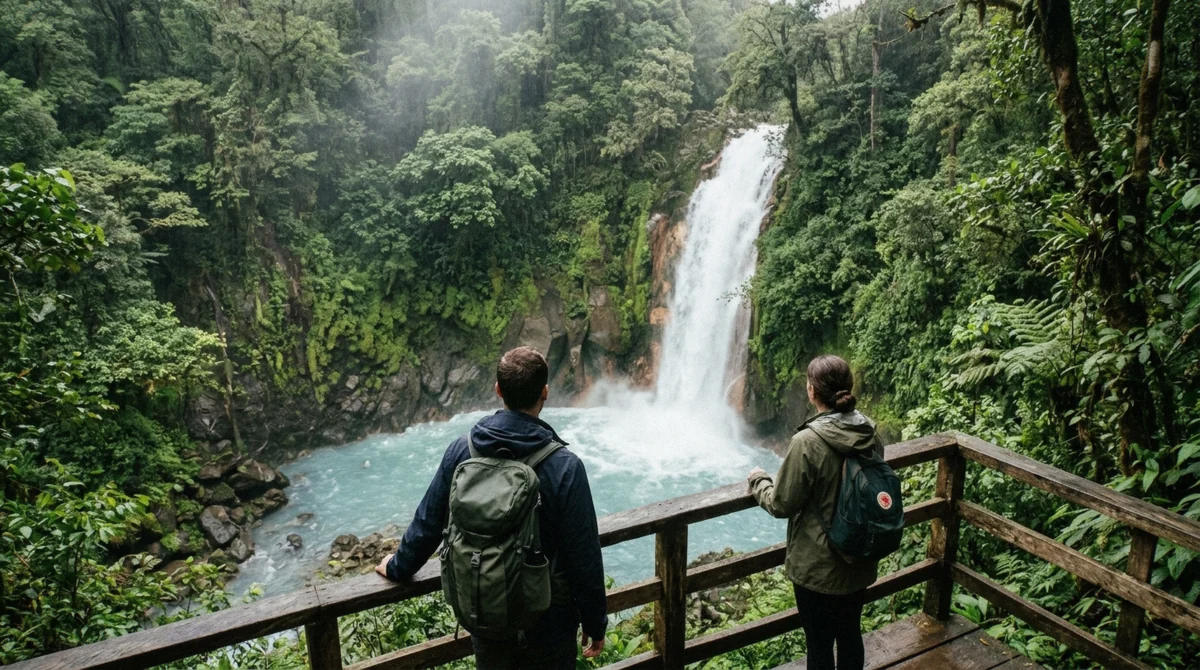
The lookout is the payoff moment, weather permitting.
Quick answer Worth it for the waterfall and blue river if you accept a long drive, no swimming and some color risk
Rio Celeste is worth it for travelers who want a genuine rainforest hike with a waterfall and a river color that exists nowhere else in the country. The trail loop takes 2.5 to 4 hours with stops, entry costs about $13.56 for foreign adults and slots must be booked ahead. The two real risks are the weather, which can turn the river green-brown, and the length of the drive, which runs 1.5 hours from La Fortuna and up to 4 from San Jose. Self-guided entry at $32 keeps the cost down if you have your own transport.
Key takeaways
- The blue is real and volcanic, but heavy rain can mute it, so timing matters
- Swimming is banned inside the park, so pick a day that adds a swim stop if that matters to you
- Compare options on the Rio Celeste tours compared with prices before you book
The Short Answer
Rio Celeste is worth it if you want one of the most unusual sights in Costa Rica and you are happy to trade a full day and a long drive to see it. The river owes its opaque sky-blue color to a chemical reaction at Los Teñideros, where two mineral-rich streams meet and scatter light into that famous blue. It is not a reflection and not a filter.
On a clear day the waterfall pouring into a blue pool looks Photoshopped in person, and reviewers keep saying the same thing. One verified booking review calls it the highlight of the entire trip and adds that you get more than what you pay for. Another describes a long drive on winding mountain roads but concludes it was well worth it, with a rare tapir sighting as a bonus.
The honest counterweight is that this is a half-day commitment at minimum once you count the drive. From La Fortuna you are looking at about 1.5 hours each way. From Liberia and the northern Guanacaste resorts it is 2 to 2.5 hours each way, and from San Jose it runs 3.5 to 4 hours and can stretch past 6 with city traffic.
There is no reliable public bus to the entrance, so your realistic options are a rental car, a shuttle or a guided day that includes transport. None of that is a reason to skip it. It just means Rio Celeste rewards a bit of planning.
The other question people ask before booking is whether the river will actually be blue. The answer depends on rain. Heavy rain loads the river with suspended sediment and the blue turns green-brown within hours.
The color returns as the sediment settles in drier weather. One reviewer whose day came after heavy rain still called the trip a highlight even though the river was not blue. That tells you the rest of the experience, the forest, the wildlife and the waterfall itself, carries the day even when the chemistry does not cooperate.
What You Get for the Money: Compare the Costs
Start with the DIY route. The official park entry for foreign adults is US$12 plus 13% tax, which comes to about $13.56, and children aged 2 to 12 pay $5 plus tax. Entry slots are capped daily, the entry window runs from 8 a.m. to 2 p.m., and tickets are bought in advance online through SINAC, the national park system, because in-person sales at the gate are not guaranteed.
If you have a car, a reserved park entrance ticket at $32 handles the slot booking for you and leaves you to hike the 3.5 to 4 km loop at your own pace in about three hours.
What does that ticket buy? The standard loop takes most visitors 2.5 to 4 hours with stops and links the waterfall lookout, the hot springs, the mud pots, the Blue Lagoon and Los Teñideros. The first 20 to 30 minutes of trail are flat and paved, then a long staircase with a railing drops to the waterfall lookout.
The trails were rebuilt so they no longer turn to mud in rain, which is a real upgrade for a park in this climate. Wildlife sightings are common but never guaranteed, with sloths, tapirs, toucans, howler monkeys and poison-dart frogs all on the list.
Guided days bundle transport, entry, a guide and usually lunch, and they run from $89 to $135 per person across the catalog. The entry fee is small, so you are mostly paying for the drive, the guiding and the logistics. Here is how the options line up on price, duration and reviews.
| Tour | Departs | Price | Duration | Rating | Reviews |
|---|---|---|---|---|---|
| Full-Day Tour from La Fortuna | La Fortuna | $89 | 8 hours | 4.73 | 698 |
| Waterfall & Slothland Excursion | Bijagua | $118 | 11 hours | 4.97 | 677 |
| Blue River Adventure hike | Bijagua | $92.31 | 8 hours | 4.95 | 346 |
| Nature Hike & Swimming | La Fortuna | $95 | 8 hours | 4.91 | 174 |
| Hike, Sloth Sanctuary & Llanos de Cortés | Guanacaste | $135 | 12 hours | 4.62 | 1178 |
| Park Entrance Ticket | Self-guided | $32 | 3 hours | 4.14 | 146 |
A few notes on reading that table. The Guanacaste triple combo looks expensive at $135, but its shared round-trip resort transport adds about $120 per person on top of the base price, so the true door-to-door cost is far higher than the headline. The Bijagua-based Blue River Adventure sits at $92.31 with lunch, all fees and taxes included, which is why it is the pick on this site.
It carries a 4.95 rating across 346 reviews, the highest rating in the comparison. If you want the cheapest possible day and you have your own wheels, the $32 entrance ticket is about a third of the price of any guided option. Figures current for Q3 2026.
| Cost question | Answer |
|---|---|
| Cheapest way in | $32 self-guided entrance ticket, plus your own transport |
| Official park entry for foreign adults | US$12 plus 13% tax, about $13.56 |
| Typical guided day | $89 to $135 per person |
| Hidden extra to watch | About $120 per person for shared transport on the Guanacaste combo, about $70 per person on the Slothland excursion |
| Entry slots | Capped daily, 8 a.m. to 2 p.m. window, booked ahead online |
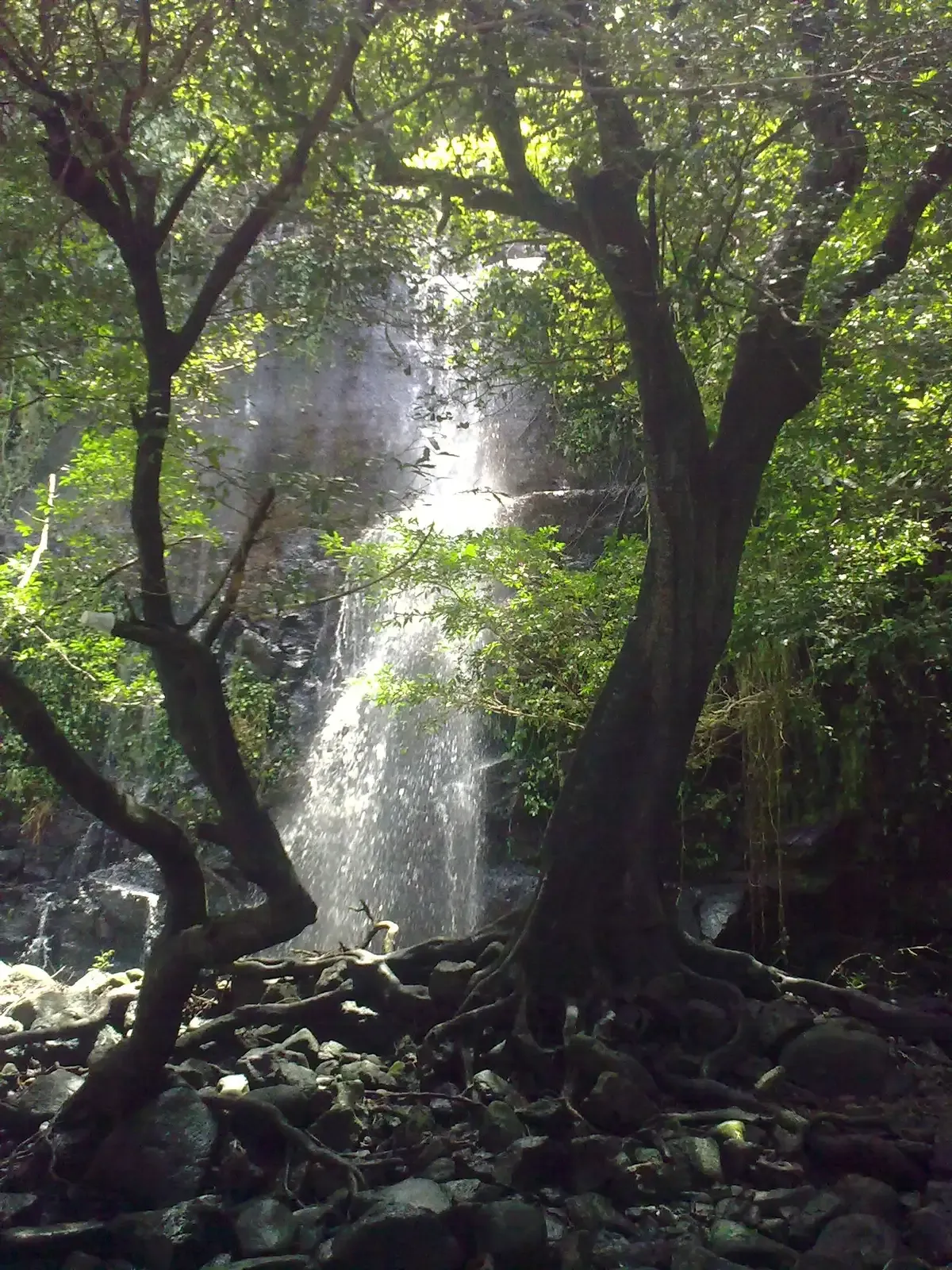
Llanos de Cortés, the region's swimmable alternative. Photo: hospedaje dodero, CC BY-SA 3.0, via Wikimedia Commons
The Honest Caveats
No verdict is useful without the downsides spelled out. Here are the five things that genuinely annoy visitors, in order of how often they come up.
- You cannot swim at Rio Celeste. Swimming is prohibited inside the national park, including at the waterfall pool. If a swim is the point of your day, look at Llanos de Cortés waterfall instead or pick a tour with a swim stop outside the protected section.
- The river can be green-brown. Heavy rain turns the color within hours as sediment overwhelms the light scattering. Check the weather and read when to visit for the best color before you lock in a date.
- It is a long drive no matter where you start. 1.5 hours from La Fortuna, 2 to 2.5 from Liberia, 3.5 to 4 from San Jose. Maps apps also often route a wrong early turn off Route 4 near San Rafael de Guatuso, so continue to Samen before turning left.
- Entry is not walk-up. Slots are capped, the window runs 8 a.m. to 2 p.m., and tickets are bought ahead online through SINAC. Show up without a booking and you may not get in.
- The hike is moderate, not a stroll. After the flat paved opening there are stairs, humidity and 3.5 to 4 km of trail, and it takes most people 2.5 to 4 hours with stops.
One more thing worth knowing before you book a guided day. Rain does not cancel tours by itself, because guided days run rain or shine unless the park itself closes for floods or landslides. That means you can end up hiking in a downpour on a river that is not blue.
Pack a rain jacket regardless of the forecast, because the forest is humid even in the dry months. And keep expectations calibrated on the wildlife too. Sightings are common but never guaranteed, and one reviewer who did see a tapir called it a very rare opportunity.
Who Should Go and Who Should Skip
Go if this sounds like you
You want a real rainforest hike, not a photo stop. You are comfortable with a full day and a long drive. You care more about the waterfall, the jungle and the color of the river than about swimming.
You are happy to book your entry slot ahead and start early. Wildlife fans get an extra nudge, since sloths, toucans, howler monkeys and the occasional tapir share the forest. If any of the six days on every Rio Celeste tour compared pages fits your base town, the logistics are already solved for you.
Skip it if this sounds like you
Swimming is the main goal and you have limited time. The park bans it outright, so build a day around Llanos de Cortés or a river spot outside the protected section instead, or pick the hike and swim day from La Fortuna which adds a swim stop after the trail. Anyone with very limited mobility should also think hard, because the trail includes stairs and unpaved sections and is not suitable for wheelchairs on the guided listings.
Finally, if you only have a morning free from San Jose, the 3.5 to 4 hour drive each way makes it a poor fit. From San Jose this is an overnight trip, not a day trip.
Color and crowds both move with the seasons. The dry months bring the surest blue and the deepest crowds, while the wettest stretch brings flood risk and occasional closures. Temperatures sit between 24 and 31 degrees Celsius all year at the park.
| Stretch | Conditions | What to expect |
|---|---|---|
| January and February | Peak dry, 27 to 28°C average | Surest blue of the year, peak crowds, book entry slots well ahead |
| March and April | Hot and dry, 29 to 30°C | Shallow pale river, start at the 8 a.m. window, Easter crowds |
| May to August | Green season, 28 to 29°C | Clear mornings, afternoon rain, vivid color, lighter crowds, July is the sweet spot |
| September and October | Wettest, 27°C | Flood surges can turn the river green-brown, occasional trail closures |
| November | Rains taper, 27°C | Color returns and the park is at its emptiest |
| December | Dry season starts, 27°C | Holiday crowds fill the morning slots |
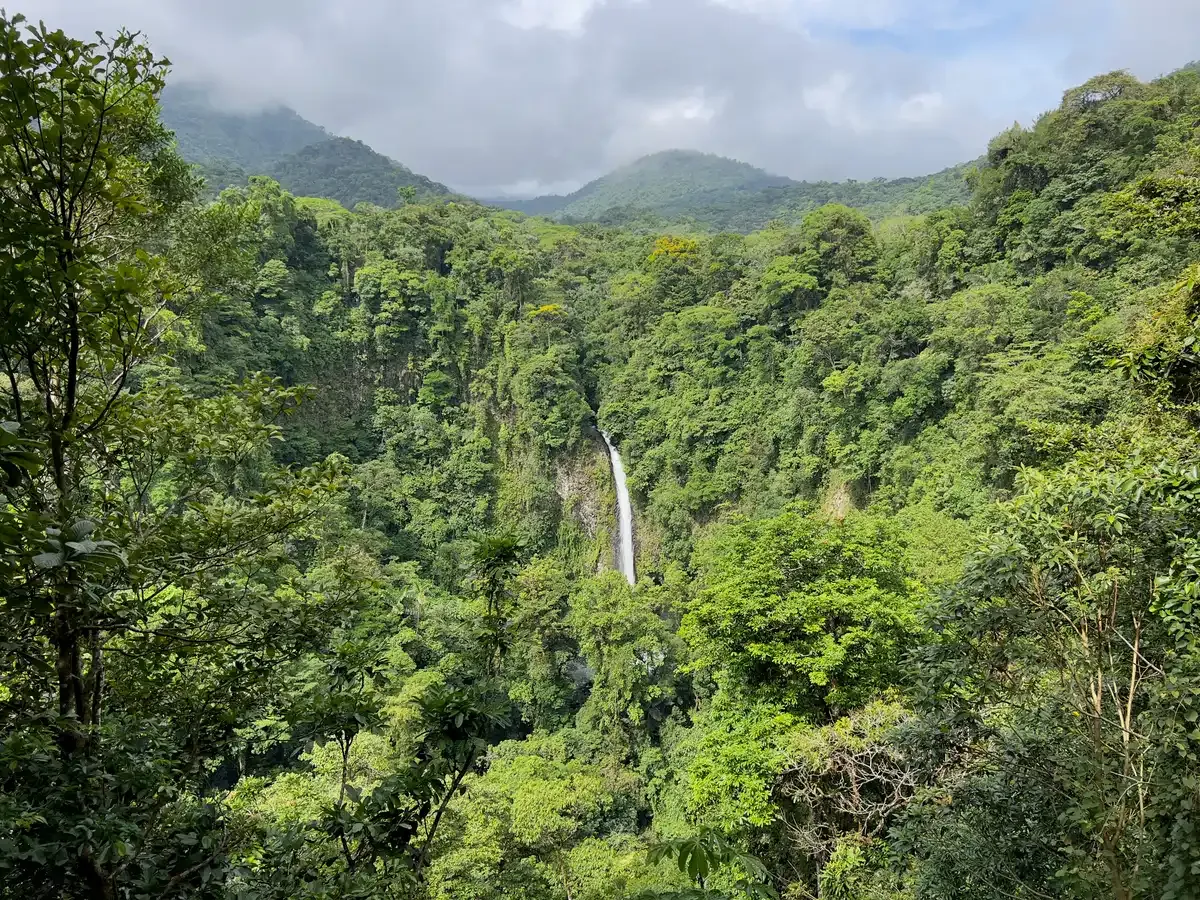
La Fortuna waterfall: closer, cheaper, swimmable. Photo: Bravodelnorte, CC BY-SA 4.0, via Wikimedia Commons
Rio Celeste or Another Waterfall
Costa Rica has no shortage of waterfalls, so the fair question is whether Rio Celeste beats the closer, cheaper options. The comparison depends entirely on what you want from the day.
Against La Fortuna waterfall
La Fortuna waterfall is close to town, cheap relative to a full-day tour and swimmable, which Rio Celeste is not. But it is a lookout and a pool, not a hike. Rio Celeste gives you a 3.5 to 4 km loop through rainforest with hot springs, mud pots, a lagoon and the color change at Los Teñideros, plus the waterfall itself.
If you have time for only one and you want the more dramatic and stranger sight, choose Rio Celeste. If you want a short outing with a swim, choose La Fortuna. Detailed trail logistics are in our hike guide and the La Fortuna route options are in how to get there.
Against Llanos de Cortés
Llanos de Cortés has a wide sandy swimming bank and sits on the Guanacaste side, so it solves the no-swimming problem at Rio Celeste. It is also less spectacular in isolation. That is exactly why the best Guanacaste listing pairs them, with a swim at Llanos de Cortés first, then the Rio Celeste hike, then a sloth sanctuary.
It is a 12-hour day and the most-reviewed option in the catalog at 1,178 reviews.
The prettiest of them all
Ask which waterfall in Costa Rica photographs best and the answer splits between La Fortuna's plunge and Rio Celeste's blue pool. Ask which one people describe as unreal in person and Rio Celeste wins more often. The color simply does not occur anywhere else in the country at this scale.
That is the core of the case for the long drive.
Verdict Questions, Answered
The FAQ below covers the questions that come up most before people commit to the day. For deeper planning, the complete visitor guide pulls the park hours, trail details and transport routes into one place, and the full comparison of guided options lives on the homepage.
The One-Paragraph Verdict for Busy People
Go, with the right expectations and the right weather window. Rio Celeste is the strangest and most beautiful color in Costa Rica's water catalogue, the trail is a fair 3.5-4 km reward for it, and the region around Bijagua and La Fortuna turns the visit into a full day that feels full. Enter at 8 a.m., carry rain gear in every month, do not plan on swimming, and treat a gray forecast as a photography gift rather than a disappointment.
Verdict Questions, Answered
What is the prettiest waterfall in Costa Rica?
There is no official title, but Rio Celeste is the most frequent answer for sheer visual impact, because the waterfall drops into a pool of opaque sky-blue water colored by volcanic minerals. Nauyaca and La Fortuna are strong rivals for scale and swimming. If the color matters most to you, read when to visit Rio Celeste to maximize your odds of seeing it blue.
Is Rio Celeste safe?
Yes, with normal precautions. The trails were rebuilt and no longer turn to mud in rain, the staircase to the waterfall lookout has a railing, and the park closes the trails in extreme weather such as flood or landslide conditions. The main risks are slippery surfaces in the rain, heat and humidity on the 3.5 to 4 km loop, and wildlife, which you should observe rather than approach. Swimming is prohibited inside the park, partly for safety around the waterfall pool.
How much does a Rio Celeste tour cost?
Guided days run from $89 for the La Fortuna full-day tour up to $135 for the Guanacaste triple combo, with the $92.31 Blue River Adventure and the $95 hike and swim day in between. The cheapest route is a self-guided park entrance ticket at $32, and the official adult park entry itself is about $13.56 with tax. Watch for transport add-ons, since shared transport on the Guanacaste listing adds about $120 per person.
Can you combine Rio Celeste with hot springs?
Yes, twice over. The hot springs sit on the standard park trail itself, between the waterfall lookout and the mud pots, so every tour and the self-guided loop pass them. Note that swimming is prohibited inside the park, so you view rather than bathe. Several guided days then add other stops, and the Slothland excursion pairs the hike with a coffee and chocolate farm, while the Guanacaste combo adds Llanos de Cortés waterfall and a sloth sanctuary.
Is Rio Celeste good for a rainy day?
It works, with managed expectations. Guided tours run rain or shine unless the park closes for floods or landslides, the rebuilt trails hold up in rain, and one reviewer whose river was not blue still called the day a highlight. The tradeoff is that heavy rain turns the water green-brown within hours, so you may miss the color. Bring a rain jacket and check the river and trail status the day before.
How does Rio Celeste compare with La Fortuna waterfall?
La Fortuna waterfall is closer, quicker and swimmable, essentially a lookout and pool visit from town. Rio Celeste is a 3.5 to 4 km rainforest loop with hot springs, mud pots, the Los Teñideros color change and a waterfall into blue water, but no swimming and a longer drive. For drama and a half-day of hiking, Rio Celeste wins. For a short outing with a swim, La Fortuna does.