 Rio Celeste Tours
Rio Celeste, Costa Rica: The Complete Visitor Guide
Rio Celeste (Costa Rica) is a sky-blue river inside Tenorio Volcano National Park in northern Costa Rica, famous for a waterfall that pours into an opaque turquoise pool. The color is real chemistry: two mineral streams meet at a spot called Los Teñideros and scatter light into blue. A visit means a 3.5 to 4 km rainforest loop that takes most people 2.5 to 4 hours, reached from the town of Bijagua. You can hike it on your own with a timed park ticket or join a guided day that bundles transport, lunch and fees. This page explains the trail, the color, the seasons and how to choose. For prices and inclusions side by side, see the full Rio Celeste tours comparison.
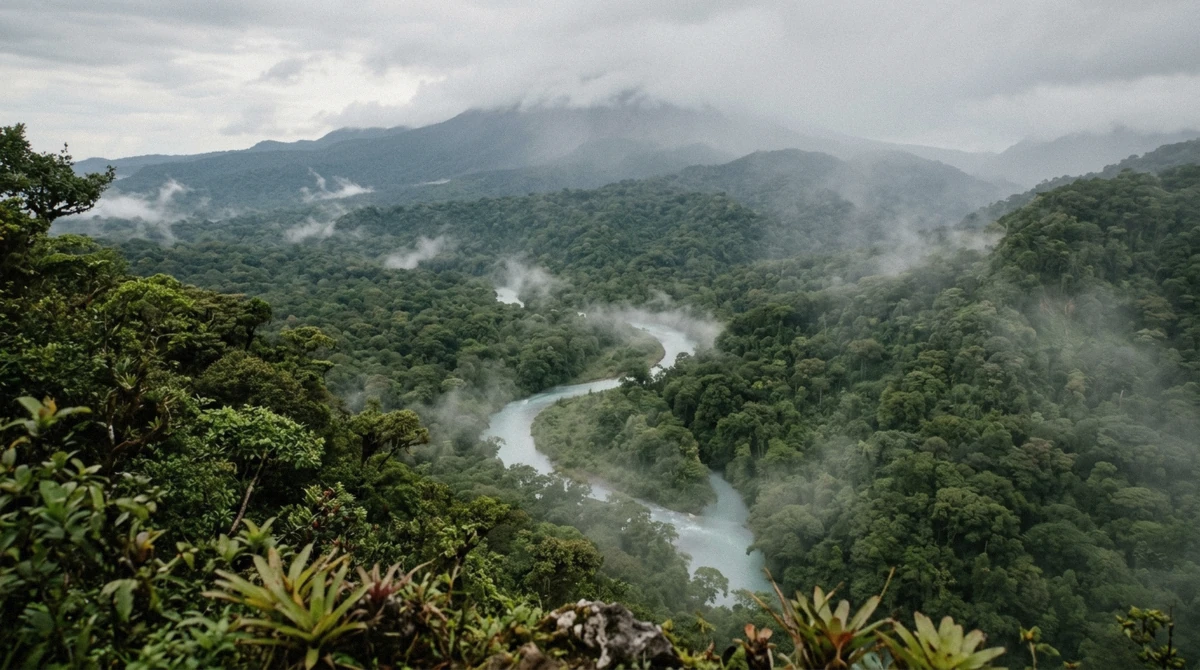
The Northern Lowlands around Tenorio: river country, mostly empty roads.
Quick answer Blue river in Tenorio Volcano National Park, reached from Bijagua, hiked in 2.5 to 4 hours
Rio Celeste is a bright blue river in Tenorio Volcano National Park, about 20 minutes from the village of Bijagua. The standard visit is a 3.5 to 4 km loop past the waterfall, hot springs, mud pots, Blue Lagoon and Los Teñideros, taking 2.5 to 4 hours. Entry is capped daily and tickets are bought online in advance through SINAC. Swimming is prohibited inside the park. The river reads bluest in dry weather and turns green-brown after heavy rain.
Key takeaways
- Buy your park entry in advance, the entry window runs from 8 a.m. to 2 p.m. and gate sales are not guaranteed
- Guided days from La Fortuna or Bijagua bundle transport, lunch and fees, or you can self-drive and use a reserved park entrance ticket
- Dry months give the surest blue, while heavy rain turns the river green-brown within hours
What Rio Celeste Is
Rio Celeste is a river, not a lake or a beach. It runs through the cloud forest on the slopes of Tenorio Volcano in northern Costa Rica, and for a stretch of its length it glows an opaque sky blue that looks retouched in photos and is not. The color holds even in a bucket, which is the first thing most visitors notice.
The blue comes from chemistry rather than reflection. Two streams carrying different volcanic minerals converge at a point on the trail called Los Teñideros, which translates roughly as the dye works. Where sulfur from one stream meets calcium carbonate from the other, the water scatters light so that it reads as a solid, milky blue.
Upstream of the meeting point both streams are ordinary clear forest water.
The river sits inside a national park, which shapes the visit. There is one visitor entrance, a fixed trail network, capped daily entries and a rulebook that bans swimming, drones and pets. What the park gives back is a rebuilt trail system, protected habitat and the wildest setting for a waterfall in this part of the country.
Where Rio Celeste Sits
The park lies in northern Costa Rica, between the Arenal region and the northern Guanacaste lowlands. The single visitor entrance sits at Pilón, about 20 minutes from the village of Bijagua on a fully paved road. Bijagua is the practical base for a self-drive visit and the meeting point for several guided days.
Drive times matter more here than for most Costa Rican sights because nothing is close. La Fortuna is the nearest tourist hub at about 1.5 hours each way. Liberia and the northern Guanacaste beach resorts run about 2 to 2.5 hours.
San Jose is the longest haul at roughly 3.5 to 4 hours, and city traffic on the way out can stretch the drive past 6 hours. Route details, turn-by-turn warnings and road conditions are covered in How to Get to Rio Celeste.
Getting there without a car
No reliable public bus runs to the park entrance. The realistic options are a rental car, a shuttle, or a guided day that includes transport. If you are staying in La Fortuna without a car, a guided day is usually the simplest answer because hotel pickup and the entrance fee are handled for you.
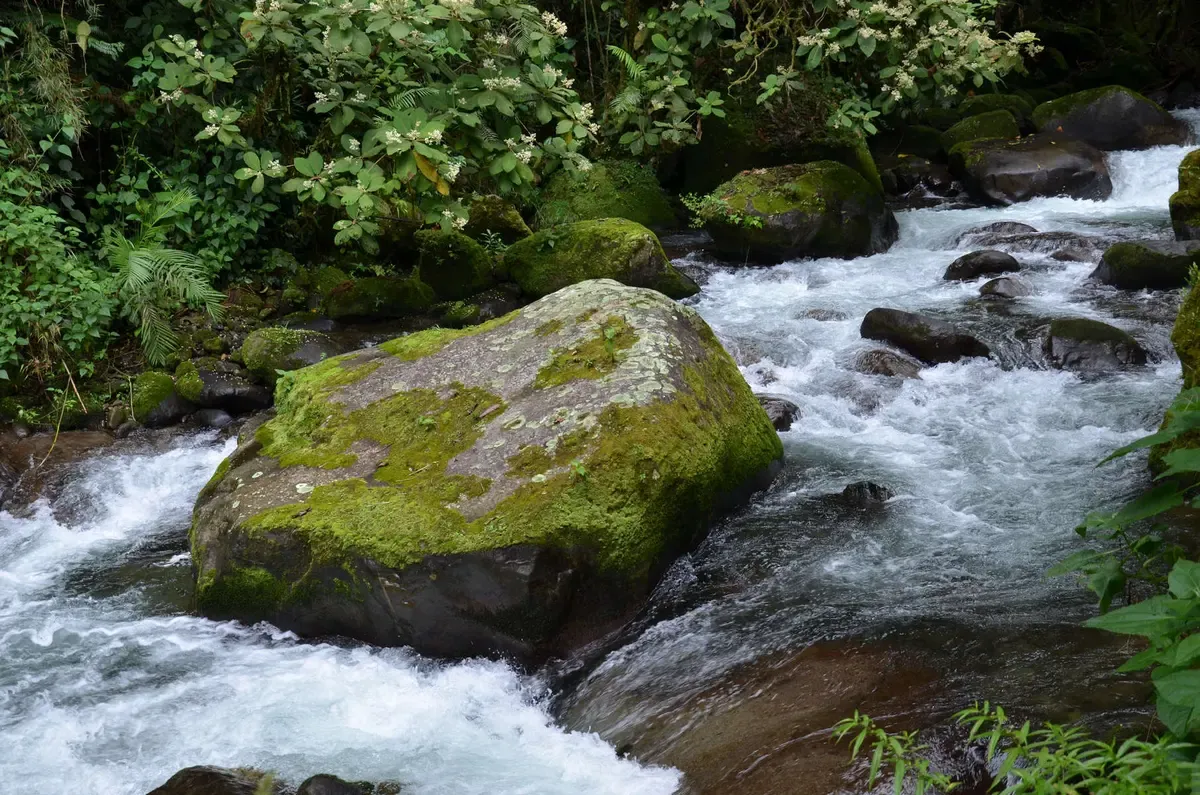
The color holds for kilometers below the mixing point. Photo: Julián Monge-Nájera, CC BY-SA 4.0, via Wikimedia Commons
The Waterfall and the Trail
The standard route is a loop of roughly 3.5 to 4 km that most visitors complete in 2.5 to 4 hours with stops. The first 20 to 30 minutes are flat and paved, which fools nobody for long. A long staircase with a railing then drops to the waterfall lookout, the single most photographed spot in the park and the moment the blue hits you.
The trails were rebuilt in recent years so they no longer turn to mud in rain, a real change from the old track.
Beyond the waterfall the loop continues past a set of named features. You can do the whole thing unguided, the trail signage is in English and Spanish, or with a guide who explains the geology and spots wildlife you would walk past. Full detail on timing, the staircase and tickets lives in The Rio Celeste Hike.
- The waterfall lookout, reached down a long railed staircase
- The hot springs along the river
- The mud pots, bubbling volcanic gray
- The Blue Lagoon, a deep blue pool in the river bend
- Los Teñideros, the mineral meeting point where the color begins
Can you swim
No. Swimming is prohibited inside the national park, including at the waterfall pool, and rangers enforce it. The known swim spots sit outside the protected section, such as the Llanos de Cortés waterfall and river holes downstream. One guided day in our comparison builds a legal swim stop into the route, our Rio Celeste hike guide covers the trail stop by stop.
How to Visit: Guided Day or Self-Guided
There are two ways in. The self-guided route means buying a timed park ticket online in advance through SINAC, driving or shuttling to the Pilón entrance and hiking at your own pace. The guided route means booking a day that bundles the ticket, transport, a guide and usually lunch.
Both start from the same trailhead and see the same river.
Entry logistics are the part that trips people up. Entry slots are capped daily, the entry window runs from 8 a.m. to 2 p.m., and in-person sales at the gate are not guaranteed. Foreign adults pay $13.56 ($12 plus 13% tax) and children aged 2 to 12 pay $5 plus tax.
A reserved park entrance ticket costs $32 and removes the uncertainty of gate sales.
Guided days differ mainly by departure point and what rides along. From La Fortuna, the most booked listing is the Rio Celeste Full-Day Tour from La Fortuna, 8 hours at $89 with entrance fee, lunch and central hotel pickup. From the quiet Bijagua side, the Rio Celeste & Tenorio Volcano Hike: Blue River Adventure covers the full trail including the volcano viewpoint, hot springs and mud pots at $92.31 with lunch, fees and taxes in the price.
If a swim is the priority, the Rio Celeste Nature Hike & Swimming at the Blue River adds a river swim outside the protected section for $95.
To help you choose, the table below lines up every option in the catalog on price, length and departure point, from the DIY ticket to the longest triple-stop day.
| Listing | Departs | Duration | Price | Rating | Reviews |
|---|---|---|---|---|---|
| Rio Celeste Full-Day Tour from La Fortuna | La Fortuna | 8 hours | $89 | 4.73 | 698 |
| Rio Celeste Waterfall & Slothland Excursion | Bijagua | 11 hours | $118 | 4.97 | 677 |
| Rio Celeste & Tenorio Volcano Hike: Blue River Adventure | Bijagua | 8 hours | $92.31 | 4.95 | 346 |
| Rio Celeste Nature Hike & Swimming at the Blue River | La Fortuna | 8 hours | $95 | 4.91 | 174 |
| Rio Celeste Hike, Sloth Sanctuary & Llanos de Cortés Waterfall | Guanacaste | 12 hours | $135 | 4.62 | 1178 |
| Rio Celeste Waterfall & Tenorio National Park Entrance Ticket | Bijagua | 3 hours | $32 | 4.14 | 146 |
Which way should you go
Self-guided suits confident drivers who want freedom over pace and the lowest cost. Guided days suit anyone without a car, and anyone who wants the mineral chemistry and wildlife explained rather than read off a sign. On price alone the comparison is blunt: the reserved ticket runs about a third of any guided day, and the difference buys transport, a guide and lunch.
You can compare all Rio Celeste tours including cancellation terms and pickup details before deciding. For a straight cost-benefit read, see Is Rio Celeste Worth It?
When the River Reads Blue
The trail is open all year, so the real questions are heat, crowd depth and how reliably the river reads blue. Heavy rain turns the water green-brown within hours as suspended sediment overwhelms the light scattering. The blue returns as the sediment settles in drier weather.
The park also closes the trails in extreme weather, and flood or landslide closures do happen in the wettest stretch.
Temperatures stay in a narrow band all year, between about 24 and 31 degrees, so season choice is about rain and crowds rather than cold. Dry months book out first and holiday periods fill the morning entry slots, while the wettest months carry the flood risk. A full month-by-month breakdown sits in When to Visit Rio Celeste.
The table below condenses the year into a planning view, with average temperatures and what each stretch of the year actually does to the river and the trail.
| Month | Avg temp | What it means for your visit |
|---|---|---|
| January | 27 (81°F) | Dry and bright, the surest blue of the year, book entry slots well ahead |
| February | 28 (82°F) | Peak dry season and peak crowds, morning entries beat the heat and the buses |
| March | 29 (84°F) | Hot and dry, the river runs shallow and pale, start at the 8 a.m. window |
| April | 30 (86°F) | Last dry month with Easter crowds, afternoon heat is the day's real limit |
| May | 29 (84°F) | Green season opens, mornings stay dry and the trail quiets down |
| June | 28 (82°F) | Afternoon rain and clear mornings, strong color most days |
| July | 28 (82°F) | The green-season sweet spot, lush forest, lighter crowds, vivid river |
| August | 28 (82°F) | Similar to July with deeper green and rising afternoon storms |
| September | 27 (81°F) | Wettest stretch begins, flood surges can turn the river green-brown |
| October | 27 (81°F) | Peak rain and occasional trail closures, check park status the day before |
| November | 27 (81°F) | Rains taper, the color comes back and the park is at its emptiest |
| December | 27 (81°F) | Dry season starts and holiday crowds fill the morning entry slots |
Manage expectations either way. One verified reviewer put it plainly after a wet visit: the water was not as blue as it could have been because it had been raining, and the guide still made the day. Another wrote that even with a green river the trip was a highlight.
A blue river is not guaranteed, a good forest walk usually is.
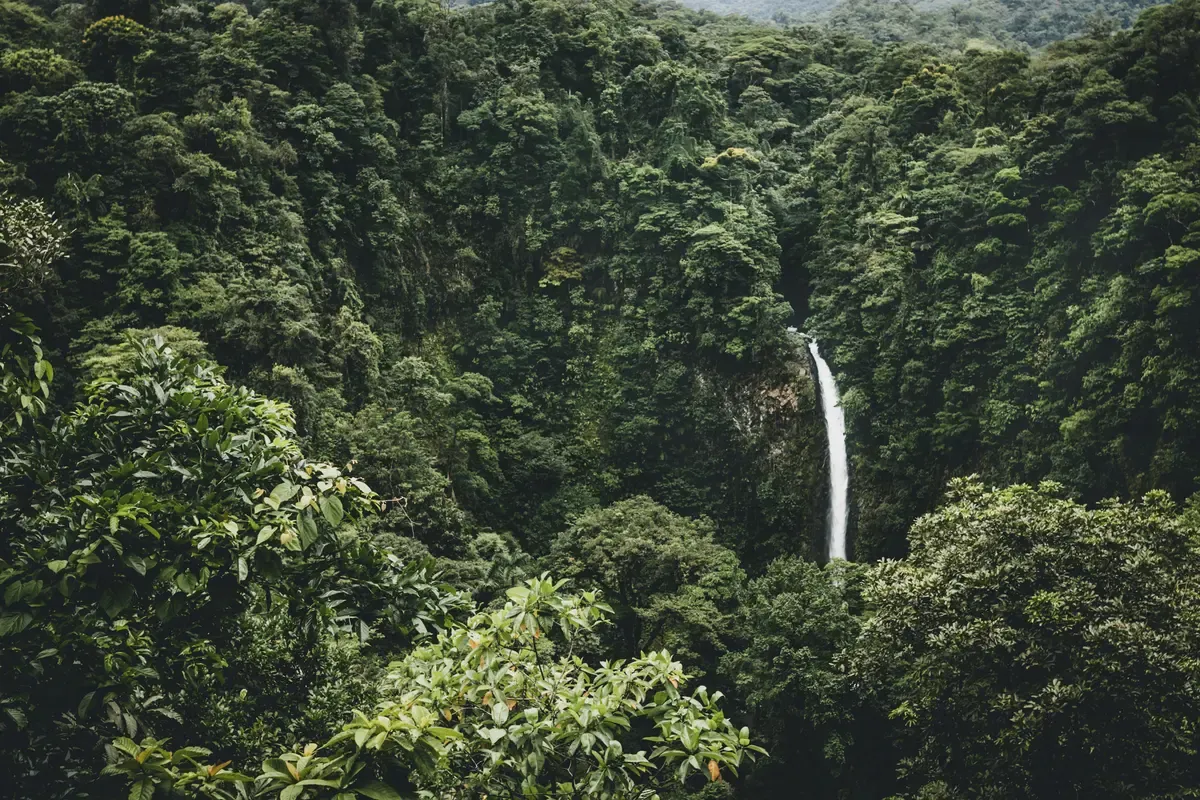
La Fortuna waterfall, the region's other big cascade. Photo: Isabella Jusková bellaskova, CC0, via Wikimedia Commons
Beyond the Waterfall
The park itself is more than one lookout. The loop strings together the hot springs, the mud pots, the Blue Lagoon and Los Teñideros, and the volcano viewpoint appears on the full-trail guided route from Bijagua. Wildlife sightings are common but never guaranteed, and the forest around the park is where several guided days earn their length.
- Sloths, best seen on the reserve stops near Bijagua rather than from the trail
- Tapirs, shy and rare, though one reviewer counted a sighting as worth the whole drive
- Howler monkeys and toucans, heard before they are seen
- Poison-dart frogs, small and bright on the forest floor
If you want the day to carry more than a hike, two listings extend it. The Rio Celeste Waterfall & Slothland Excursion is the highest-rated option in the comparison at 4.97 across 677 reviews, pairing the park hike with sloth watching at Slothland Bijagua and a coffee and chocolate farm. The Rio Celeste Hike, Sloth Sanctuary & Llanos de Cortés Waterfall is the most reviewed at 1,178 reviews, a 12-hour day from the Guanacaste resorts that adds a swim at Llanos de Cortés, the one waterfall stop where getting in the water is allowed.
Note that shared transport on that listing adds roughly $120 per person to the base price.
Combination days trade depth for breadth. A 3-hour self-guided loop shows you the whole blue river in miniature, while a 12-hour triple-stop day spreads the same trail across a longer, busier schedule with two extra stops bolted on. Families and short itineraries tend to do better with the focused options.
Visitor Questions, Answered
The questions below come up every time people plan this trip. Short answers here, deeper pages linked where they exist.
What a Visit Actually Costs: Compare the Ways In
The park's own entry fee is the floor of every budget: foreign adults pay US$12 plus 13% tax, about $13.56, and children aged 2 to 12 pay $5 plus tax. Around that floor the day can cost nothing more, if you drive yourself and carry your own lunch, or it can look like the guided listings in the comparison, where transport, interpretation and food push the day to $89 to $135 per person. Both readings are honest; the difference is what you want from the hours you spent driving there.
| Way in | Cost per person | What it buys |
|---|---|---|
| Self-guided with own car | about $13.56 entry, plus the drive | The full loop, your own pace, no lunch |
| Reserved ticket, own car | $32 | The same trail with a guaranteed slot |
| Guided day from La Fortuna | $89 | The road, the guide, lunch and the entry fee |
| Guided combos | $118 to $135 | The hike plus sloths, farms or a second waterfall |
Figures current for Q3 2026.
The Region Around the Park
Bijagua itself deserves half a day if you are driving. The village sits in the green shadow of the volcano, and the small reserves and lodges around it, such as the sloth reserves on the valley floor, put wildlife in front of you with none of the trail's effort. Birders do well here: toucans, aracaris and hummingbirds work the flowering hedges, and the pastures at dusk often carry the silhouettes of armadillos and owls.
On the other side of the day, the La Fortuna side of the volcano owns the hot springs, the Arenal activities and most of the region's restaurants. The honest geography: Rio Celeste sits between the two hubs, closer to Bijagua but better serviced from La Fortuna, which is why most travelers sleep in La Fortuna, drive out in the morning, and spend the evening in a hot spring rather than behind a rental-car wheel.
Where to Base Yourself: La Fortuna or Bijagua
La Fortuna is the practical base for almost everyone: the hotels, the restaurants and the tour departures all sit there, and the 1.5-hour drive to the park is a standard morning commute in both directions. Bijagua is the connoisseur's base: a quiet farm town twenty minutes from the gate, a handful of lodges with volcano views, and wildlife in the hedges, at the cost of dining on whatever your lodge cooks. Travelers chasing the 8 a.m. entry with a rental car often spend one night in Bijagua and the rest of the week in La Fortuna, and that split is the local optimum.
The third option, staying on the Guanacaste coast, only makes sense with a guided day: the resort pickups leave before 7 a.m. precisely because the coast sits 2 to 2.5 hours away, and doing that drive twice in a rental car on a beach holiday takes real conviction.
Visitor Questions, Answered
How far is Rio Celeste from San Jose?
The drive runs about 3.5 to 4 hours each way and can stretch past 6 hours with city traffic on the way out of San Jose. Most visitors base in La Fortuna, 1.5 hours away, rather than day-tripping from the capital.
What town is Rio Celeste in?
The river runs inside Tenorio Volcano National Park, and the visitor entrance sits at Pilón about 20 minutes from the village of Bijagua. Bijagua is the practical base for self-guided visits and the meeting point for several guided days.
Do you need a guide for Rio Celeste?
No, the trail is well signed in English and Spanish and most of the route is self-explanatory. A guide adds geological explanation and far better wildlife spotting, which is what guided days sell. A reserved entrance ticket covers the self-guided route.
How much time do you need at Rio Celeste?
Plan 2.5 to 4 hours for the 3.5 to 4 km loop with stops at the waterfall, hot springs, mud pots, Blue Lagoon and Los Teñideros. The entry window runs from 8 a.m. to 2 p.m., so a morning slot leaves the whole afternoon free.
Is Rio Celeste open year round?
Yes, the trail is open all year. The park closes the trails in extreme weather, and floods or landslides occasionally shut things down in the wettest stretch, so check park status the day before in peak rain season. When to Visit Rio Celeste covers the month-by-month detail.
Is Rio Celeste good for kids?
Yes, with caveats. The first stretch of trail is flat and paved, but the waterfall lookout requires a long staircase and children aged 2 to 12 pay a $5 plus tax entry fee. Swimming is prohibited inside the park, which some kids find frustrating, so a day with a swim stop outside the park can be the better family fit.